There are two ways to make more money from your Shopify store.
Get more customers. Or get each customer to spend more.
Most store owners focus entirely on the first option. More ads, more traffic, more customers. But acquiring a new customer is expensive — often $20 to $50 or more when you account for advertising costs. Getting an existing customer, or a customer who's already on your site and ready to buy, to spend more costs you almost nothing.
Your average order value (AOV) is the average amount customers spend per transaction. If your AOV is $45 and you can raise it to $65, you've increased your revenue by 44 percent without spending a single extra dollar on ads.
The instinct most store owners have when they want to increase AOV is to run a sale or offer a discount. But discounts increase order value while simultaneously reducing margin — you're getting more in the cart but keeping less of it. That's not a win.
These strategies increase what customers spend without touching your prices.
Strategy 1 — Free Shipping Threshold
This is the single highest-impact AOV strategy available to most Shopify stores, and it costs you nothing to implement.
The psychology is simple: customers hate paying for shipping. They will add items to their cart to avoid it — even if the items they add cost more than the shipping would have.
If your average order value is $45 and you set your free shipping threshold at $65, a customer with $45 in their cart sees "Spend $20 more for free shipping" and thinks about what else they want. Many of them find it.
How to set the threshold correctly
Your threshold should be set 20 to 30 percent above your current average order value. High enough to encourage customers to add more, low enough that it feels achievable.
If your AOV is $45, set the threshold at $55 to $60. If you set it at $100 when the average cart is $45, customers will feel like it's out of reach and won't try.
Make the threshold visible throughout the shopping experience
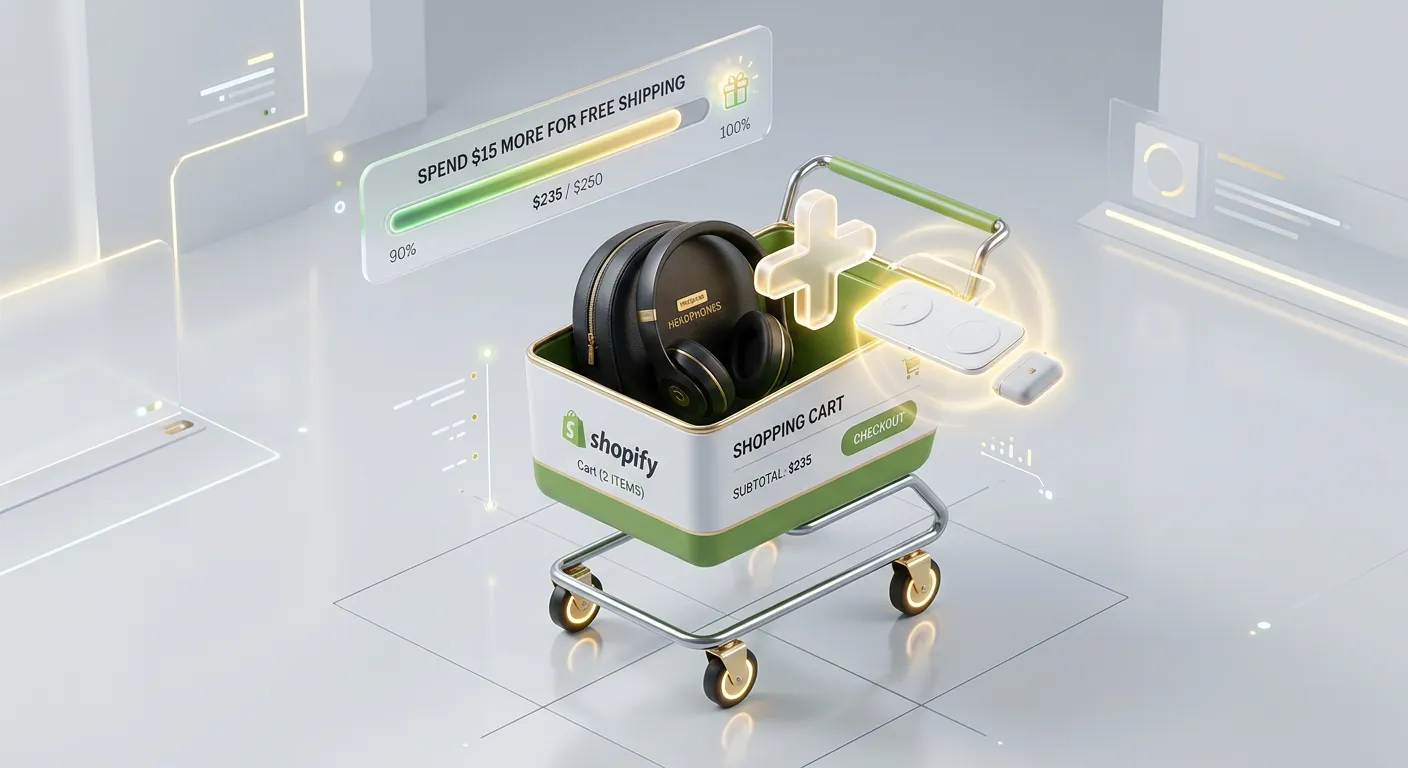
A progress bar in the cart that shows customers how close they are to free shipping is one of the most effective AOV tools in e-commerce. "You're $12 away from free shipping" with a visual progress bar gets customers adding items.
Many Shopify themes support this natively or with minor code changes. There are also several well-rated apps that add this functionality if your theme doesn't support it.
Strategy 2 — Product Bundles
Bundles let you group complementary products together and sell them as a set — usually at a slight discount from buying each piece individually, but at a higher total transaction value.
The customer feels like they're getting a deal. You get a higher AOV. Both sides win.
Types of bundles that work
Complementary product bundles. Group products that are naturally used together. A coffee store bundles a grinder, a scale, and a bag of beans. A skincare store bundles a cleanser, serum, and moisturizer into a starter routine. A clothing store bundles a shirt, pants, and belt into a "complete outfit."
Volume bundles. Buy 2 get 10% off, buy 3 get 15% off. Works well for consumable products — candles, supplements, coffee, skincare. Customers who love the product stock up, increasing AOV while also locking in future purchases.
Gift bundles. Pre-curated gift sets at multiple price points. "The Starter Gift — $45" and "The Premium Gift — $95" give customers a clear, easy decision when buying for someone else. Gift buyers often have a higher price tolerance than buying for themselves.
How to implement bundles in Shopify
Shopify's native "frequently bought together" recommendations provide a basic version of this. For proper bundle products with combined pricing, you'll need either a bundle app or to create bundle products manually as new product listings.
The manual approach — creating a new product called "The Starter Kit" that includes three items — is completely free and works well for a small number of defined bundles.
Strategy 3 — Strategic Upsells and Cross-Sells
An upsell is offering a customer a better or larger version of what they're already buying. A cross-sell is suggesting a complementary product alongside what they're buying.
Both increase AOV. The key is doing them at the right moment and making them feel genuinely helpful rather than pushy.
The right moments for upsells
On the product page — "Customers who bought this also bought" or "Complete the set" recommendations. These work best when the suggestions are genuinely relevant, not just random products from your catalog.
In the cart — Before the customer goes to checkout, a cart upsell or cross-sell gives them one more chance to add something. Keep it to one suggestion, not five. One relevant suggestion feels helpful. Five suggestions feel desperate.
Post-purchase — The thank you page after a completed order is an underused upsell location. The customer is in a positive state of mind — they just bought something they wanted. A "customers who bought this also love..." recommendation here has a conversion rate that surprises most store owners.
What makes a good upsell
The suggested product should be genuinely related to what the customer is buying. It should be priced at 25 to 50 percent of the original order value — suggesting a $150 add-on to someone buying a $40 product rarely works. And it should feel like a recommendation, not a sales pitch.
"People who buy the Coffee Grinder usually grab a Gooseneck Kettle too — here's why" is more effective than "ADD THIS TO YOUR ORDER — LIMITED TIME."
Strategy 4 — Minimum Order Quantities and Volume Pricing
For stores selling products that customers buy in multiples — consumables, gifts, accessories — setting minimum quantities or offering volume pricing can significantly increase AOV.
Instead of selling one candle at $28, offer:
- 1 candle — $28
- 3 candles — $75 (save $9)
- 6 candles — $138 (save $30)
Customers who were going to buy one often buy three when the math is presented clearly. Customers who were going to buy three often buy six.
This strategy works particularly well for:
- Candles, soaps, and home goods
- Supplements and wellness products
- Coffee and food products
- Socks, underwear, and other basics
- Any product people buy as gifts
Strategy 5 — Gift Wrapping and Personalization Options
This is a simple add-on that many stores ignore.
Offer gift wrapping for $4 to $8. Offer a personalized message card for $3 to $5. Offer custom engraving or monogramming for a premium.
These additions cost you very little — a few minutes of time and minimal materials — but they add meaningful value to the customer and increase AOV with almost no downside.
More importantly, they make your store better for gift buyers. And gift buyers are among the highest-value customers in e-commerce — they have a specific budget in mind, they're less price-sensitive than buying for themselves, and they often buy from stores they've used before.
Make sure your gift options are visible on product pages and in the cart, not hidden in a checkout note field.
Strategy 6 — Loyalty Points That Encourage Larger Orders
A loyalty program that rewards customers with points for spending encourages them to spend more to reach point thresholds.
"Earn 1 point for every $1 spent. Redeem 100 points for $5 off" encourages customers to round up their order to hit the next points milestone. "Earn double points on orders over $75 this weekend" is a promotion that increases AOV without offering a discount on the current order.
The key difference between loyalty points and discounts: loyalty points create a reason to come back and spend again. A discount just reduces your margin on the current transaction.
Measuring Your AOV Improvement
Track your AOV in Shopify Analytics under Reports → Sales. Before implementing any of these strategies, note your current AOV. Then implement one strategy at a time and measure the impact over two to four weeks.
Implement them in this order for maximum impact: Week 1: Free shipping threshold + cart progress bar Week 2: Bundle your top 3 products into sets Week 3: Add post-purchase upsell recommendations Week 4: Add gift wrapping option at checkout Month 2: Launch volume pricing on consumable products Month 3: Evaluate loyalty program based on repeat purchase rate
A realistic outcome from implementing all of these well is a 20 to 40 percent increase in AOV over three to six months. On a store doing $15,000 per month, that's $3,000 to $6,000 in additional monthly revenue — from the same number of customers, the same ad spend, the same traffic.
The best part about AOV optimization is that it makes every other part of your business better. More revenue per customer means your advertising becomes more profitable. Your customer acquisition cost stays the same but the return on each customer goes up. Your profit margins improve because your fixed costs are spread across more revenue.
If you're not sure which of these strategies makes the most sense for your specific store and product mix, I'm happy to take a look and give you a prioritized recommendation.