You launched your Shopify store three weeks ago.
You've told your friends and family. You've posted on your personal Instagram. You made a business page and posted three times.
You have 4 customers. Two of them are your mom.
This is the most common place new store owners find themselves — and the most common response is to open Facebook Ads Manager and start spending money on ads. That's almost always the wrong move at this stage.
Here's why: ads amplify what's already working. If your product messaging isn't clear, your photos aren't compelling, and your store doesn't convert — ads will drain your budget and confirm your fears that "this doesn't work." Before you spend a dollar on ads, you need proof that people want what you're selling and that your store can convert them when they arrive.
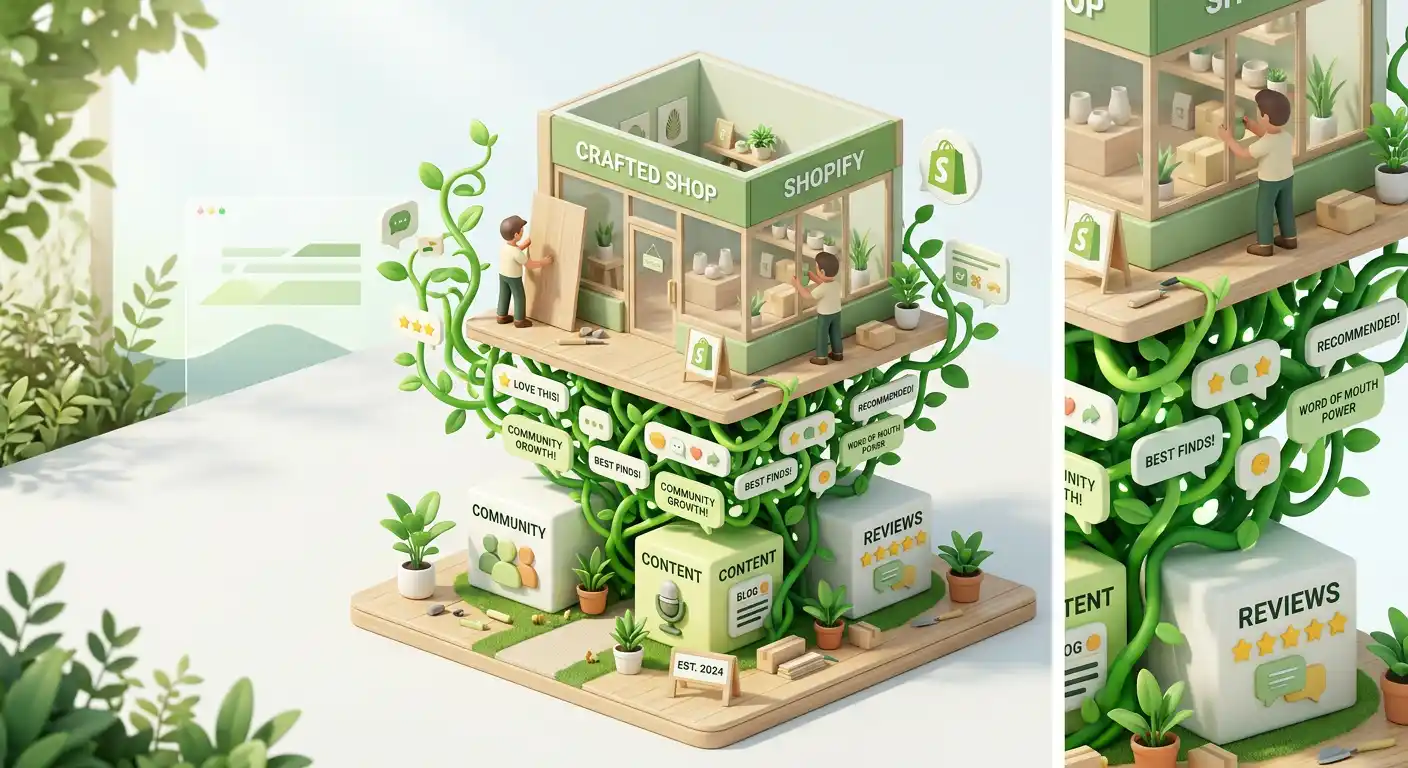
Your first 100 customers give you that proof. And you can get them without spending anything on advertising.
Why the First 100 Customers Are Different
Getting your first 100 customers is a fundamentally different problem from scaling to 1,000 or 10,000. At scale, systems and channels matter. At the beginning, personal effort and direct relationships are your most powerful tools.
The goal of your first 100 customers is not profit. It's learning.
Every customer who buys from you teaches you something: what messaging resonated, what objections came up, what they loved about the product, what they wished was different. By the time you have 100 customers, you know your customer better than any market research could tell you. And that knowledge makes every subsequent marketing decision better.
Approach this phase as research, not revenue. The revenue will follow.
Strategy 1 — Start With the People Who Already Know You
The fastest path to your first customers is through people who already trust you. That means your existing network — and using it more deliberately than just posting on your personal social media.
Make a direct ask to specific people
Open your phone contacts. Think about every person in there who might genuinely benefit from or be interested in your product. Not everyone — the specific people for whom your product is actually relevant.
Write them a personal message. Not a copy-paste blast — a personal message that mentions something specific about them and why you thought of them.
Something like:
"Hey Sarah — I know you've been really into running lately. I just launched a store selling [product] and I thought of you immediately. Would you be open to trying it? I'd love your honest feedback — and happy to give you a discount as a thank you."
This is not spam. This is a personal outreach to someone who knows you, about something that's relevant to them. The conversion rate on this kind of outreach is dramatically higher than any ad you could run.
Do this for 30 to 50 people. You will get some customers. More importantly, you'll get conversations that teach you how people respond to your product.
Ask your early customers to tell someone
Every time someone buys from you in this early phase, reach out personally. Thank them. Ask for honest feedback. And then ask:
"Is there anyone you know who might love this? I'd really appreciate it if you'd share it with them."
Word of mouth from a satisfied customer to a friend is the highest-converting form of marketing that exists. It costs you nothing except the effort of asking.
Strategy 2 — Go Where Your Customers Already Are
Your potential customers are spending time somewhere online right now — in Facebook groups, subreddits, Discord servers, forums, and communities built around the interest or problem your product addresses.
Find those places and become a genuine, helpful member.
The right way to do this
Don't join a community and immediately post about your store. That's spam and you'll be removed. Instead:
Spend two weeks just participating. Answer questions. Share useful information. Help people with problems related to your product's niche. Build a reputation as someone who knows their stuff and is genuinely helpful.
Then, when it's natural — when someone asks a question your product directly answers, or when you've earned enough credibility to share what you've built — mention your store. At this point, it won't feel like an ad. It'll feel like a recommendation from someone the community trusts.
Where to find these communities
Reddit — Search for subreddits related to your product category. If you sell coffee equipment, r/Coffee and r/espresso are where your customers are. If you sell fitness products, r/fitness, r/weightlifting, and dozens of more specific subreddits.
Facebook Groups — Search Facebook for groups related to your niche. Many of these groups have tens of thousands of members who are actively discussing problems your product solves.
Discord servers — Increasingly, niche communities are moving to Discord. Search for servers related to your category.
Niche forums — Many product categories still have active dedicated forums. Running forums, cooking forums, craft forums — these are often older communities with highly engaged members.
The key principle is: be genuinely helpful first. The customers come as a result of being helpful, not as the goal of being helpful.
Strategy 3 — Create Content Around Your Customer's Questions
Your potential customers are typing questions into Google right now. Questions about the problem your product solves, how to choose between options in your category, how to use products like yours effectively.
If you create content that answers those questions — blog posts, videos, social media posts — you become the resource they find. And a person who found you by searching for help with a problem is far more likely to buy from you than someone who saw an ad.
Start with the questions you know your customers have
Think about every conversation you've had about your product. What do people ask? What do they not understand? What misconceptions do they have? What do they want to know before they'd feel comfortable buying?
Each of those questions is a piece of content.
If you sell skincare products, you might write:
- "How to build a morning skincare routine for beginners"
- "What's the difference between a toner and an essence"
- "Why your moisturizer might be making your skin oilier"
If you sell coffee equipment:
- "Why your home espresso tastes bitter (and how to fix it)"
- "French press vs pour over — which one is right for you"
- "How to dial in your grinder for better coffee"
These pieces of content rank in Google over time, bring in organic traffic, and establish you as the expert in your category. They also give you material to share in the communities we talked about in Strategy 2.
Which format to start with
Start with whatever format comes most naturally to you and where your specific audience spends time.
If your audience is on YouTube, start a YouTube channel. If they're on Instagram, create Instagram content. If they're in text-based communities, write blog posts.
Don't try to be everywhere at once. Pick one channel, create consistently for 90 days, and see what gets traction before expanding.
Strategy 4 — Reach Out to Micro-Influencers in Your Niche
Influencer marketing sounds expensive because you're thinking of the wrong influencers.
A celebrity or major influencer with a million followers charges thousands of dollars for a post — and their audience is so broad that most of their followers are not your customer.
A micro-influencer with 5,000 to 50,000 highly engaged followers in your specific niche is often willing to work with new brands for free product — and their audience is exactly the people you want to reach.
How to find micro-influencers
Search Instagram, TikTok, and YouTube for content related to your product category. Look at the accounts posting content your potential customers would watch. Check their engagement rate — comments and genuine interactions relative to follower count — not just their follower number.
An account with 8,000 followers and 200 genuine comments per post is more valuable than an account with 80,000 followers and 50 comments.
How to reach out
Keep your outreach message short, personal, and specific. Mention something specific about their content that you genuinely liked. Explain what your product is and why you thought they'd be interested. Offer to send them a free product with no obligation to post — just to try it.
Some will say no. Some will ignore you. Some will try the product and love it and post about it. That post to their highly engaged niche audience is worth more than almost any ad you could run at this stage.
Send 20 to 30 of these messages. Expect 3 to 5 positive responses. Those 3 to 5 posts can bring in dozens of customers each.
Strategy 5 — List on Marketplaces and Comparison Sites
While you're building your own traffic, you can tap into existing traffic on marketplaces and comparison sites.
Etsy — If your products fit Etsy's categories (handmade, vintage, craft supplies, unique products), listing there gives you access to millions of buyers actively looking to purchase. Use it as an acquisition channel, not your primary store.
Google Shopping — Setting up Google Merchant Center and connecting it to your Shopify store gets your products listed in Google Shopping results. This is not the same as running paid Shopping ads — organic product listings are free and appear in Google's Shopping tab.
Pinterest — Pinterest functions as a visual search engine. Products and content pinned on Pinterest continue to drive traffic for months or years. If your product is visually appealing, Pinterest is worth setting up and posting consistently.
Product Hunt — If your product has any tech angle or novelty factor, launching on Product Hunt can drive a significant spike in traffic and early customers.
The key with marketplaces is to treat them as acquisition channels that funnel customers into your ecosystem. When someone buys from you on Etsy, get their email address (if they opt in), follow up with excellent service, and invite them to shop directly on your Shopify store next time.
Strategy 6 — Local and Offline Channels
Depending on your product, offline channels can be your fastest path to early customers.
Local markets and pop-up events — Selling at a local market or pop-up event puts your product directly in front of people. They can touch it, see it, ask questions, and buy immediately. More importantly, every conversation teaches you how people respond to your product in person — what language they use, what questions they ask, what makes them decide to buy or not buy.
Local press and media — Local newspapers, blogs, and news sites are always looking for interesting local business stories. A new, interesting product with a good story behind it is genuinely newsworthy at the local level. A single article in a local publication can bring in dozens of customers and costs nothing except the time to reach out.
Local businesses — Are there businesses in your area whose customers overlap with yours? A yoga studio that might stock your wellness products. A coffee shop that might carry your coffee accessories. A boutique that might carry your fashion items.
Wholesale relationships with local businesses give you immediate sales and put your product in front of their established customer base. Even a consignment arrangement — where you place products and only get paid when they sell — gets your product in front of real customers with no upfront cost.
The 100 Customer Tracker
Here's a simple way to organize your effort: Week 1-2: Personal Network ───────────────────────────────────────── □ List 50 specific people who might be interested in your product □ Send personalized messages to each one □ Follow up once if no response Target: 5-15 customers
Week 3-4: Community Engagement ───────────────────────────────────────── □ Find 3-5 online communities in your niche □ Join and start participating genuinely □ Answer 5+ questions per community per week □ Share your store when naturally appropriate Target: 10-20 customers
Month 2: Content + Influencers ───────────────────────────────────────── □ Write or record 4 pieces of content answering real customer questions □ Reach out to 20-30 micro-influencers □ List on 1-2 relevant marketplaces □ Set up Google Merchant Center Target: 30-50 customers
Month 3: Compound the Gains ───────────────────────────────────────── □ Ask every customer for a review □ Ask every happy customer for a referral □ Continue content creation consistently □ Follow up with influencer relationships □ Explore local channels if relevant Target: Reach 100 customers
What to Do When You Hit 100
By the time you have 100 customers, you know things you couldn't have known before:
- What made people decide to buy
- What almost stopped them from buying
- Which channels brought the most engaged customers
- What customers love most about the product
- What they wish was different
Use this knowledge to improve your store, tighten your messaging, and identify which of these organic channels showed the most promise. Then — and only then — consider using paid ads to amplify what's already working organically.
Ads work best when you know exactly who your customer is, what message resonates with them, and that your store converts them when they arrive. Your first 100 customers give you all of that.
If you've been trying to get traction on your Shopify store and nothing seems to be working, I'm happy to look at what you're doing and tell you where the specific gaps are.