Everyone talks about scaling like it's obviously a good thing.
More ads. More traffic. More products. More channels. More everything.
But scaling is not inherently good. Scaling is amplification — it makes whatever you have bigger. If what you have is working, scaling makes it work more. If what you have is broken, scaling makes it more broken, faster, and at greater cost.
The store owners who burn through $20,000 in ad spend and get nothing are not bad at marketing. They scaled before they were ready.
This guide is about figuring out when you're actually ready to scale — and what to focus on until that point.
What Scaling Actually Means
Before anything else, let's be precise about what scaling means, because it gets used loosely in a way that causes confusion.
Scaling means increasing your inputs — ad spend, inventory, team, channels — in a way that produces a proportional or greater increase in revenue and profit.
Spending $1,000 on ads and making $3,000 in revenue is not necessarily scaling. It might be profitable, but it's one transaction. Scaling is when you can spend $10,000 on ads and make $30,000 — reliably, repeatedly, and predictably.
The "reliably, repeatedly, and predictably" part is what most stores are missing when they try to scale.
The Signs You're Not Ready to Scale Yet
Be honest with yourself as you read through these. Every one of these problems becomes dramatically worse when you scale.
Your conversion rate is below 2%
If 100 people visit your store and fewer than 2 buy, something about your store is not working. Putting more traffic through a store that converts at 1% means more people leave without buying — at a higher cost per visitor.
Before scaling traffic, get your conversion rate to at least 2 to 3 percent. Ideally higher. A store that converts at 4% with $5,000 in ad spend will dramatically outperform a store that converts at 1% with $20,000 in ad spend.
You don't know where your current customers are coming from
If someone asked you right now "where do your customers come from?" and you couldn't answer specifically — not "social media" but specifically which platform, which content, which audience — you are not ready to scale.
Scaling requires knowing what's working so you can do more of it. If you don't know what's working, scaling means spending more money on everything and hoping something sticks.
Your unit economics don't work
Unit economics means the profit math on a single customer or a single sale.
If you're paying $30 to acquire a customer through ads, and your average order value is $35 with a 50% margin (meaning you make $17.50 gross profit per order), you're losing $12.50 on every customer you acquire.
Scaling that means losing $12.50 multiplied by however many more customers you bring in. More volume does not fix broken unit economics — it accelerates the losses.
Before scaling, know your numbers:
- Average order value
- Cost of goods sold
- Gross margin per order
- Customer acquisition cost
- Average customer lifetime value
If the math doesn't work at your current scale, it won't work at a larger scale. Fix the math first.
Your fulfillment is already struggling
If you're already having trouble fulfilling orders on time, handling customer service, or managing inventory at your current volume — scaling will break your operations.
A customer who orders from you and has a bad experience — delayed shipping, wrong item, no response to their support request — is unlikely to come back. They might leave a negative review. They might charge back their purchase. At scale, operational failures compound into reputation damage that's very hard to recover from.
You have no repeat customers
If almost all of your customers buy once and never return, you have a retention problem that scaling will not fix.
New customer acquisition is expensive. Repeat customers are profitable. A store where customers come back drives significantly more lifetime value from every marketing dollar spent. If your repeat customer rate is near zero, something about the product, the experience, or the follow-up isn't working — and spending more to bring in new customers who also won't come back is not a scaling strategy, it's a subsidy.
The Signs You Are Ready to Scale
These are the signals that tell you scaling will amplify success rather than amplify problems.
You have a conversion rate above 3%
Your store is converting visitors reliably. The product page works, the checkout works, the offer is right. When more people come, more of them will buy.
You know exactly which channel brings your best customers
You can point to a specific source and say: "Customers who come from this Instagram audience and see this specific creative buy at this conversion rate, spend this average amount, and come back this percentage of the time."
That specificity is what makes scaling possible. You're not guessing what to put more money into — you know.
Your unit economics are positive with room
Not just barely profitable — clearly profitable with room to absorb the increased costs that come with scaling (more customer service volume, more returns, potential fulfillment challenges).
A healthy target before scaling aggressively: customer acquisition cost should be no more than one-third of average customer lifetime value.
You have organic demand you can't fulfill
When customers are finding you without paid ads, sharing your products unprompted, and coming back without being retargeted — that's proof of genuine product-market fit. Scaling is adding fuel to a fire that's already burning. This is the best possible position to scale from.
Your operations can handle more volume
You have reliable inventory supply. Your fulfillment process is documented and consistent. Your customer service has clear processes. You can handle two or three times your current order volume without everything falling apart.
What to Fix Before You Scale
If you're not ready yet, here's the order of operations:
Fix your conversion rate first
A conversion rate problem is a store problem — photos, copy, trust signals, page speed, checkout friction. Identify which part of your funnel is losing people and fix it before spending more on traffic.
Install Microsoft Clarity (free) and watch real session recordings. You will see exactly where customers are dropping off. Fix those specific things.
Fix your unit economics second
If your margins are too thin for profitable customer acquisition, you have three options: increase prices, reduce cost of goods, or increase average order value through bundles and upsells.
Increasing prices is often more viable than store owners expect. If your product is genuinely good, a 10 to 20% price increase often has minimal impact on conversion rate while dramatically improving your profit margin per sale.
Fix your retention third
Set up post-purchase email flows. Ask every customer for a review and a referral. Create a reason for customers to come back — a loyalty program, a complementary product, a subscription option.
Even moving your repeat purchase rate from 5% to 15% changes the economics of customer acquisition significantly. When customers are worth more over their lifetime, you can afford to spend more to acquire them.
Then scale
Once these fundamentals are in place, scaling becomes a process of adding fuel to a working engine rather than hoping more fuel will fix a broken one.
How to Scale Without Breaking Things
When you are ready to scale, do it gradually and measure carefully.
Scale ad spend in 20% increments
Don't double your ad spend overnight. Increase it by 20%, let it run for a week, measure the results. If the metrics hold — conversion rate, cost per acquisition, return on ad spend — increase by another 20%.
Sudden large increases in ad spend often cause performance to drop because the algorithm has to relearn your audience with a much larger budget. Gradual increases give the algorithm time to adjust.
Scale one channel at a time
If Facebook ads are working, scale Facebook before adding Google. If Google is working, scale Google before adding TikTok. Adding multiple new channels simultaneously makes it impossible to know what's working and dramatically increases the complexity of your marketing operations.
Watch your operational metrics as closely as your marketing metrics
As volume increases, watch:
- Order fulfillment time — is it staying within your promised window?
- Customer service response time — are tickets piling up?
- Return rate — is it increasing as volume grows?
- Inventory levels — are you at risk of stockouts?
A stockout during a scaling push wastes every dollar you spent on ads to bring in customers you can't serve. Stay ahead of your inventory.
Keep a scaling budget reserve
Don't put every available dollar into scaling immediately. Keep a reserve — at least 20 to 30% of your scaling budget — to handle the unexpected: a sudden increase in returns, an inventory problem, a platform account issue, a customer service surge. Scaling without a buffer puts your entire operation at risk if anything goes wrong.
The Scaling Readiness Checklist
Conversion & Store ────────────────────────────────────────── □ Conversion rate above 3% □ Mobile conversion rate above 2% □ PageSpeed score above 60 on mobile □ Cart abandonment rate below 70% □ Average order value stable or growing
Unit Economics ────────────────────────────────────────── □ Gross margin above 50% □ Customer acquisition cost below one-third of customer lifetime value □ Profitable at current ad spend level □ Return rate below 10%
Customer & Retention ────────────────────────────────────────── □ Repeat purchase rate above 15% □ Post-purchase email flows active □ Review collection process in place □ Customer satisfaction measurably positive
Operations ────────────────────────────────────────── □ Fulfillment consistently on time □ Customer service response under 24 hours □ Inventory supply reliable and scalable □ 90+ days of inventory visibility
Marketing Clarity ────────────────────────────────────────── □ Know which channel brings best customers □ Know which creative/message converts best □ Know customer acquisition cost by channel □ Have proven ad creative before scaling spend
If you can check every box in this list, you're ready to scale. If there are unchecked boxes, those are your priorities before increasing spend.
The Most Important Thing
Scaling is not a goal. Profit is a goal. A sustainable business is a goal.
Many store owners scale their revenue to impressive numbers while their profit stays flat or goes negative — because they scaled before their unit economics worked, or they scaled operations that couldn't handle the volume, or they scaled marketing for a product that customers didn't love enough to come back for.
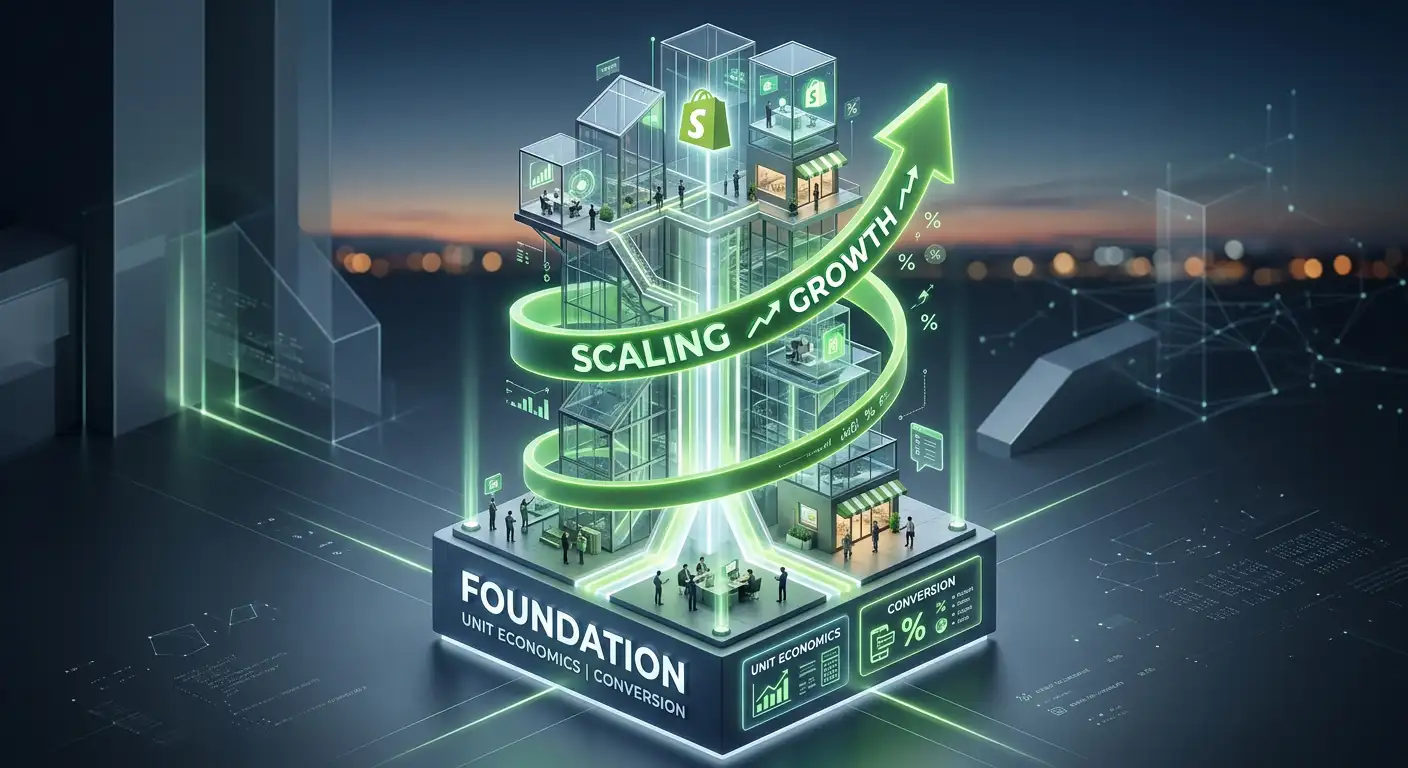
Build the foundation first. The scale will be worth it when you do.
If you're trying to figure out whether your store is ready to scale or what's holding it back, I'm happy to look at your specific numbers and tell you where to focus.