Your Shopify store is getting traffic from Germany, the Netherlands, France, Belgium, and Sweden.
Your US conversion rate is 3.2%. Your EU conversion rate is 0.9%.
You've checked your product pages. The translations look fine. The prices are in euros. Shipping times are reasonable.
But Europeans are leaving at checkout at a rate that makes no sense compared to your other markets.
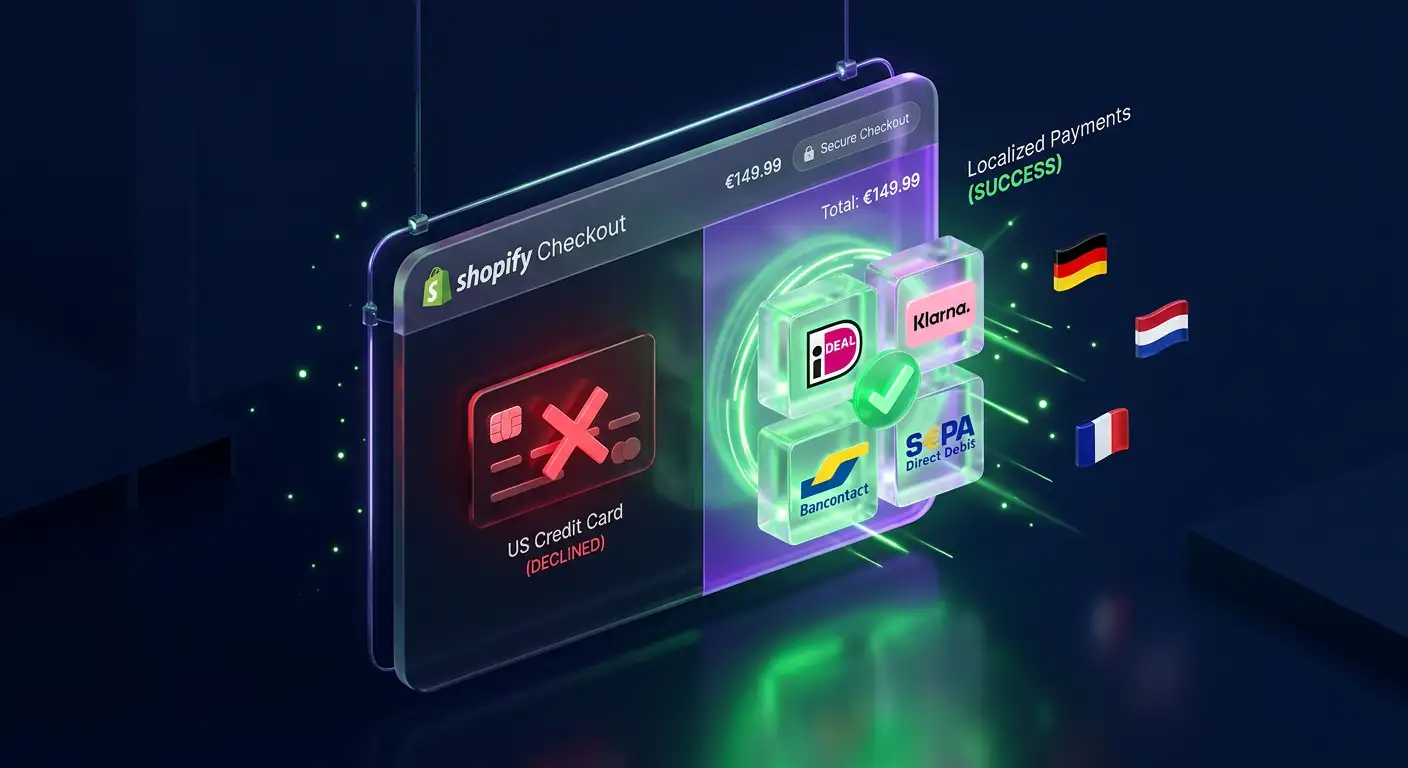
Here's what's happening: you're asking European customers to pay in a way they don't trust, don't prefer, and in many cases actively avoid.
Payment preferences in Europe are dramatically different from payment preferences in the US — and they vary significantly between European countries. A checkout that works perfectly for American customers can feel wrong, unfamiliar, or untrustworthy to a Dutch, German, or Swedish customer.
This guide explains what European customers actually expect at checkout, which payment methods are essential for each major EU market, and how to set them up on your Shopify store.
Why Payment Preferences Are So Different in Europe
In the US, credit cards are the dominant payment method. Most Americans have a Visa or Mastercard and use it for online purchases without thinking twice.
European payment culture developed differently. Many European countries built strong national payment systems before credit cards became widespread — systems that are trusted, instant, and deeply embedded in how people manage their money. These systems became the default for online payments in their respective countries, and credit card penetration in many EU markets remains significantly lower than in the US.
When a European customer reaches your checkout and sees only credit card options, two things happen:
First, many of them genuinely don't have a credit card, or have one they don't use for online purchases. In countries like Germany and the Netherlands, a significant portion of the population prefers not to use credit cards for online shopping — they see it as debt they don't need.
Second, the absence of their familiar payment method signals something: that this store doesn't know them, doesn't serve them, and might not be legitimate. Trust is built through familiarity, and an unfamiliar checkout is an untrustworthy checkout.
The Netherlands — iDEAL Is Not Optional
If you're selling to Dutch customers, iDEAL is not a nice-to-have. It's the payment method. Approximately 70% of all online payments in the Netherlands are made via iDEAL.
iDEAL is a bank transfer system that lets Dutch customers pay directly from their bank account through their bank's secure interface. It's instant, it's free for customers, and every Dutch person with a bank account has used it for online shopping.
When a Dutch customer reaches your checkout and doesn't see iDEAL, they leave. Not because they can't pay with a card — most can — but because paying without iDEAL feels unusual and less secure to them. The conversion drop-off is significant and measurable.
How to set up iDEAL on Shopify
iDEAL is available through Shopify Payments (in the Netherlands) and through several payment gateways including Mollie and Adyen. If your store is based in the Netherlands and you're using Shopify Payments, iDEAL should be available in your payment settings.
If you're based outside the Netherlands, you'll need a payment gateway that supports iDEAL cross-border. Mollie is widely used for this — it supports iDEAL along with most other European payment methods through a single integration.
Germany — Bank Transfer and Invoice Are Expected
Germany has a unique payment culture that frequently surprises non-German merchants. Germans are notably cautious about online payments. They prefer to pay after receiving goods rather than before — and they have strong preferences for specific payment methods that reflect this.
SEPA Bank Transfer (Lastschrift) — Direct bank debit is widely used in Germany. Customers provide their IBAN and payment is pulled directly from their account. It's familiar and trusted.
Purchase on Invoice (Kauf auf Rechnung) — This is uniquely significant in Germany. Paying on invoice means the customer receives the goods and then pays within a set period (typically 14 or 30 days). This is the preferred method for a large segment of German online shoppers because it eliminates the risk of paying for something before they've confirmed it's what they expected.
Klarna — Klarna originated in Sweden but is deeply embedded in the German market. It provides the "pay later" functionality Germans expect through a trusted, recognizable brand.
PayPal — PayPal has unusually high trust and penetration in Germany compared to most other markets. Many German online shoppers specifically look for PayPal as a trust signal.
What this means for your store
A checkout that offers only credit cards to German customers is missing the payment methods that a large portion of the German market prefers. Adding PayPal alone will improve your German conversion rate. Adding Klarna will improve it further. Adding SEPA direct debit and invoice payment will make your store feel genuinely designed for German customers.
Belgium — Bancontact Is the Standard
In Belgium, Bancontact is the dominant payment method for online purchases. Similar to iDEAL in the Netherlands, Bancontact is a bank-linked payment system that Belgian customers use as their default online payment method.
Belgians have Bancontact cards — they look like standard debit cards but process through the Bancontact network rather than Visa or Mastercard. Many Belgian customers use their Bancontact card for online purchases specifically because the liability protections and familiarity feel more secure than international card networks.
Without Bancontact, you're excluding a payment method that a large segment of Belgian online shoppers actively prefers. Mollie and Stripe both support Bancontact and can be integrated with Shopify.
Sweden, Norway, Finland — Klarna's Home Market
Klarna was founded in Sweden and has a presence in Nordic markets that goes beyond being a payment option — it's culturally embedded in how Scandinavians think about online shopping.
In Sweden, Norway, and Finland, offering Klarna is not just about providing a buy-now-pay-later option. It's about speaking the language of how Nordic customers think about online purchases. The ability to pay after receiving and inspecting goods — and to split payments if needed — is expected by a significant portion of Nordic shoppers.
Beyond Klarna, Swish (in Sweden) is a mobile payment system used by the vast majority of Swedish adults for everything from splitting restaurant bills to online purchases. For stores doing significant volume in Sweden, Swish integration dramatically reduces checkout friction for Swedish mobile shoppers.
France — Carte Bancaire and PayPal
France is more credit-card-friendly than Germany or the Netherlands, but with an important distinction: French customers prefer Carte Bancaire — the French domestic card network — over international Visa and Mastercard networks.
Most French cards are co-branded (Carte Bancaire/Visa or Carte Bancaire/Mastercard), so they work on international networks. But the Carte Bancaire authentication and processing system is what French customers are familiar with, and payment failures that work on international networks sometimes fail on French domestic processing — causing checkout failures that the customer attributes to your store being unreliable.
Making sure your payment gateway properly supports French card processing — not just international Visa/Mastercard — reduces checkout failures for French customers.
PayPal also has strong penetration in France and functions as an important trust signal for French online shoppers who are cautious about sharing card details with unfamiliar stores.
The Universal EU Additions — Every Store Needs These
Regardless of which specific EU markets you're targeting, these payment options improve conversion across the board:
PayPal
PayPal is recognized and trusted across all EU markets. For customers who are uncertain about a new store, PayPal provides a layer of purchase protection that makes them more comfortable completing the transaction. It's not the preferred primary payment method in most EU markets, but its presence as an option builds trust across all of them.
Shopify makes PayPal integration straightforward — it should be enabled in your payment settings if it isn't already.
Klarna
Klarna operates in 45 countries and has strong recognition across most EU markets. Its "pay later" and installment options address the European preference for paying after receiving goods. For higher-priced products, Klarna significantly reduces the psychological barrier to purchase.
Klarna integrates with Shopify through the Klarna app in the Shopify App Store.
Apple Pay and Google Pay
Mobile payment adoption in Europe is high. Apple Pay and Google Pay let mobile customers check out with a single touch, without entering card details. In markets where mobile shopping is dominant — which increasingly means all of them — these options reduce friction at the most critical point in the purchase process.
Both are available through Shopify Payments and most major gateways.
The Payment Gateway Question
If you're currently using Shopify Payments, you have access to some European payment methods — but not all of them, and availability varies by country.
For stores doing meaningful volume in EU markets, a dedicated European payment gateway alongside or instead of Shopify Payments gives you access to the full range of local payment methods:
Mollie — Based in the Netherlands, supports iDEAL, Bancontact, SEPA, Klarna, Giropay, and most other European payment methods through a single integration. Pricing is transparent and competitive. Widely used by European Shopify merchants.
Stripe — Supports most European payment methods including iDEAL, Bancontact, SEPA Direct Debit, Giropay, and Sofort. Strong developer documentation and Shopify integration.
Adyen — Enterprise-focused, used by larger merchants. Supports virtually every European payment method but has higher setup complexity and minimum volume requirements.
For most growing Shopify stores expanding into EU markets, Mollie provides the best combination of European payment method coverage and straightforward Shopify integration.
What This Looks Like in Practice
Here's a simple framework for which payment methods to prioritize by market: Netherlands ──────────────────────────────────── Must have: iDEAL, PayPal Good to add: Klarna, Apple Pay, Google Pay
Germany ──────────────────────────────────── Must have: PayPal, Klarna, SEPA Good to add: Purchase on invoice, Apple Pay, Google Pay
Belgium ──────────────────────────────────── Must have: Bancontact, PayPal Good to add: Klarna, Apple Pay, Google Pay
Sweden / Norway / Finland ──────────────────────────────────── Must have: Klarna, PayPal Good to add: Swish (Sweden), Apple Pay, Google Pay
France ──────────────────────────────────── Must have: PayPal, proper French card processing Good to add: Klarna, Apple Pay, Google Pay
All EU Markets ──────────────────────────────────── Always include: PayPal, Apple Pay, Google Pay, Klarna
text
Testing Your EU Checkout
After adding European payment methods, test your checkout from each target market's perspective.
Use a VPN to simulate a connection from the Netherlands, Germany, or Belgium and go through your entire checkout process. Does the relevant local payment method appear? Does it work correctly? Does the checkout language and currency feel right?
Payment methods that are configured but not displaying correctly — due to currency mismatches, country restrictions, or gateway configuration issues — are a common technical problem that only shows up when you test from the customer's perspective.
When This Requires Technical Help
Adding payment gateways to Shopify is generally straightforward through the admin interface. But getting everything working correctly — particularly when you're using multiple gateways, handling multiple currencies, or trying to show specific payment methods only to customers from specific countries — often requires technical configuration beyond what the basic admin allows.
Common technical issues that need developer attention:
Payment methods appearing for the wrong countries, currency conversion not working correctly with local payment methods, checkout flow breaking when switching between payment options, and tracking and analytics not properly attributing sales from different payment methods.
If your EU conversion rate is significantly lower than your other markets and you've verified your payment methods are set up — having a developer audit your checkout configuration often reveals technical issues in the payment flow that aren't visible to you but are creating friction for customers.